I am generally not one for asymmetrical things, as I am a complete organizational neat freak. I need balance in all things. Equal parts distance and same height is where I am most comfortable. I thought I would share with you some asymmetrical things that don’t make me want to scream.
I really love the asymmetric look of jackets. This one in particular is so lovely and so out of my price range 😉
Nail art has blown up. Some of it is horrific and some of it is really extraordinary. This is one of my favorites that I have seen so far.
I have this dress in black from American Apparel. I think every woman should own this because its comfortable, hip, sexy and can be dressed down and up. Click the image to be taken to the site.
Today we are so excited to present a holiday guide to bubbly that our friend Catherine, of the fabulously named Grapes of Cath, graciously put together for us. Cheers!
“This wine is too good for toast-drinking, my dear. You don’t want to mix emotions up with a wine like that. You lose the taste.” -Count Mippipopolous, from “The Sun Also Rises”
In a scene from one of Hemingway’s greats, Count Mippipolous is referring to an unnamed though, presumably, very good bottle of Champagne which he is sharing with two fellow characters, expatriates living in Paris during the crazy party days of the 1920’s. Now, I don’t know if a Champagne is too good for toast-drinking (is a toast only as good as the wine that is used? Or the intention of its participants? A combination?), however, many may be too pricey for toast-drinking. Practicality and ease on the wallet are important during times of toasting a-plenty! Fortunately, when it comes to sparkling wines, it is very possible to satisfy Champagne tastes on a (higher end) beer budget.
Though bubbles are best at any time of year, I particularly enjoy them around the holidays. Satiating and cheerful, I feel they are well-suited for the endurance required during yuletide socialization. It can sometimes be tricky to know whether an unknown bottle is quality or crap. Use your head, shop at smart spots, ask for help, check the back label for a wine’s importer. Don’t be afraid to get creative with your choices…embrace the spirit of effervescence and try something totally new!
Sparkling wines are made in practically all of the world’s wine producing areas. Composed of different grapes and using varying methods, price, flavor profile, quality, and value certainly vary. Local tradition, style, and politics also play a role in the story of each sparkling. There is always a big picture, eh?
Here are just a few ideas to throw into the arena- some of my personal favorites- a few particular wines and some general styles- all tried and true:
An individual label through Schloss Muhlenhof, from the Rheinhessen, Germany, Perlwein is a frizzante, or slightly sparkling, style of wine made in Germany. This producer was a delightful find for me this summer. Lighthearted and palate-cleansing bubbles.
Schramsburg is a sparkling winery located in Calistoga, at the northern tip of California’s Napa Valley. Founded by Jacob Schram, a German man who understood real wine and the capabilities of Napa’s terroir. Schramsburg’s sparklings are made in the traditional method and aged in the estate’s hauntingly impressive caves, which were dug by Chinese laborers in the late 1800’s.
Cava is often a great value as part of its legal qualifications require that it be produced méthode champenoise (second fermentation occurs in bottle). Cava mainly comes from northeast Spain and is composed of a blend of three native Spanish grapes (macabeu, parellada, and xarel-lo), the Llopart in particular tastes of quality far beyond its price- dry, bright red berries, brilliant acidity.
Coming from the northern Italian region of Lombardy, sparkling wine produced in Franciacorta is made in the traditional method using chardonnay, pinot bianco, and pinot nero, harvested from the area’s extremely interesting mineral composition. The name of the DOCG implies venerable quality. An interesting, deliciously toasty, and inexpensive Franciacorta project is pulled off by the folks of Quattro Mani (label features a big ‘ole “Q”).
Italian bubbles
There are so many! Italy is home to hundreds and hundreds of indigenous grape varieties. The country is full of regions, and those regions are full of towns, and many of those towns has a style of sparkling wine all its own. Prosecco and lambrusco are some of the better known, sparkling erbaluce and sparkling verdicchio are some of the lesser. If you grab a good producer, it is worth the gamble.
I’ve lumped these goodies together, though each is quite distinct. In France, the word “crémant” placed before a geographic location is pretty much saying that a wine is produced in this place in the same way of Champagne in terms of yields, harvest, and vinification, and that it should result in a similar standard of quality. The name of its place is the indicator of its terroir and typical grapes.
Because, even though all the rest are really awesome in their own way, Champagne is still Champagne in all its chalky soil glory. Champagne Aubry is a small grower located around the city of Reims, owned by brothers, more than half of its blend is coming one of the three Champagne grapes, pinot meunier. So real – and completely fair in price.
Last week’s post explored how social networks connect people. Operating as their own organisms, these networks are strongest and most helpful to the people within them when network connections carry love – altruism, reciprocity, trust, sympathy, compassion and generosity. Because we can’t find objective truth, or a definite reality in which we exist, what really binds us together and defines our reality are our sympathies and our social bonds. In a sense, love is the only reality. In many ways, we exist only because of our relation to other people and other things. Now, let’s look past the connectors (people) to the connections themselves and try to see just the lines between the dots, our social bonds.
(Click on the images to go to their source)
“There is no true person unless there are two entering into communication with another. The isolated individual is not a real person. A real person is one who lives in and for others. And the more personal relationships we form with others, the more we truly realize ourselves as person.”
-English Orthodox Bishop and Oxford Theologian Kallistos Ware
Social bonds exist not just between individuals; they are actual parts of our social networks. These bonds give our networks structure and energy. They act as some of the strongest personal motivators in existence and are not easily broken. The movie “The Corporation” makes this clear, asking the question, “What makes good people do bad things on behalf of some corporations?” The answer is the same thing that made the Grinch give back Christmas – our social bonds.
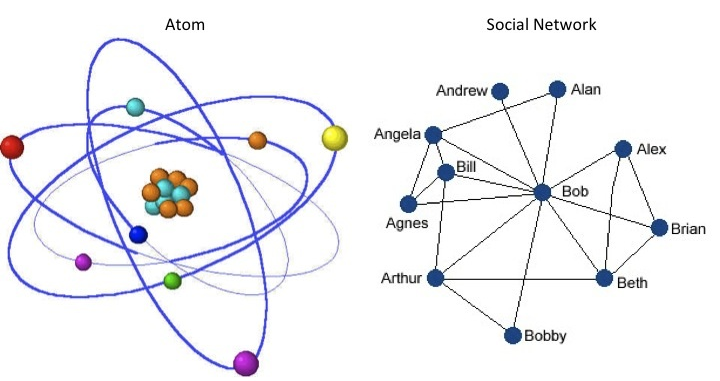
All connections are just energy in some form, and connections are everywhere and in everything – including ourselves. We know everything is made up of atoms, and atoms are almost entirely composed of the space between particles. Then, from atoms to molecules to organs to human beings to social networks we are, strikingly, unconsciously part of – and somewhat controlled by – this series of networks. This continues on to ecosystems, planets, solar systems, etc.
Art is the connections that exist between images and our senses, such as a shirt being loud or something sounding sweet. The golden ratio is an expression of the relative nature of art and science.
Einstein’s theory of relativity states something similar. It explains gravity connecting things as well as the interaction of space and time. Everything is connected, or relative. And e=MC2 literally means that all matter is energy; even the smallest amount of matter is an unimaginable amount of energy. Seen together, everything is energy and everything is connected, operating with varying waves and vibrations.
Back to social networks, our connections are everywhere and exponentially outnumber us. They can be carrying love or hate, positivity or negativity. We can literally create atmospheres of love or social environments that feel toxic.
We just discovered that connections can overpower us; they are predictive of 70% of our behavior. But just because love is binding us together doesn’t mean that we can stop acting for ourselves.
Some people consciously manipulate social networks and restrict connections (Union busting and Middle Eastern tyranny are prime examples of this type of action). Our networks can unconsciously hurt us as well. Rioting Penn State students were likely just trying to show their love and loyalty, but they were tragically misguided. The students in question were allowing their hearts and the connections between them to trump their brains, which were hopefully telling them that their coach has flaws. If people don’t stand up and speak up for what they believe, then our networks can become dangerous places. This is no small task, because social networks will react to individuals who introduce damaging truths or behaviors.
The good news is that we have far more influence than we realize, and standing up for your beliefs can be contagious both for yourself and others. Plus, there seems to be a natural equilibrium of fairness within our networks and a demand for natural balance and harmony within ourselves. Thinking and acting for yourself can be scary, but it’s critical to the well being of your social network, which thrives on openness and honesty. To heal a network that cycles negativity (be it civil war or family feuds),try honesty and forgiveness.
Suddenly, lessons from childhood ring true:
“Your integrity is paramount, protect it at all costs.” – Dad
“Know thyself.” – Mom (and a many other)
“Trust in yourself, do what’s right.” – Suz (Godmother)
“Be your own best friend, don’t beat up on yourself.” – Me
90% of life is showing up.
Remember, the only reality we know is the one that socially binds us together, most likely with love . You and your social network need strong, loving, independent influences. So be as good to yourself as possible and be the person we all need. Then invest some love into your social networks, it will compound and come back to you – especially because the number of connections in our world is exploding.
Happy Birthday Teds! We wanted to celebrate our little brother today by sharing with you a mix he made for us all. Here’s to you Teddy! You have been the coolest since the day you were born. We love you!
Tracklist:
Monster Rally – Ghosts (edit)
Yalls – Germs
Strong Arm Steady – Chittlins & Pepsi
The Mighty Hannibal – Fishin’ Pole
Charlie Electric Guitar Band’s Sound of Japan – Diamond
Vanilla – C’mon
Rimar – WAYS
MF DOOM – Eucalyptus/Poo-Putt Plater
Linval Thompson – I Love Marijuana
Madlib – Anthenagin’
Octopus Jones – Orgasma
Madvillian – 3.214
The Caretaker – A Relationship With The Sublime
Hey Party People! Happy Monday. We hope you had a lovely weekend. We asked our friends from around the world to send us a picture they took. Here is what they had to share. Thanks friends!
Also, here is a lovely picture of a plethora of lights 🙂 Happy Saturday!
I enjoy the passion behind this writing on the misuse of the words ‘myriad’ and ‘plethora’. I was not aware of their distinction but won’t forget it now.
“Myriad has company in its misuse, for we also commonly abuse the force and poetry of the word ‘plethora.’ Both words suggest huge numbers, but they are opposites in that myriad has positive connotations and plethora has negative ones.
Plethora implies superfluity and waste. It is the grasshopper blight. It’s too much of something, resulting in crisis. So it should be used to describe only items you wish to be recognized as exceedingly negative.
There may be a plethora of insects, social diseases, threats to wellbeing; but you’d be unwise to refer to a plethora of new styles or a plethora of benefits for your clientele.
Unlike myriad, ‘plethora’ is followed by ‘of:’ a plethora of damaging storms, a plethora of enemy attacks. Listen to the contrasting sounds of the words ‘plethora of’ and ‘myriad.’ The former sounds like a pest, the latter like a miracle.
The poetics of language are myriad; let us not defeat their beauty with a plethora of careless writers.”
Farrell’s college friends have a pretty stellar music club, which they’ve been kind enough to include me in. I discovered this song on one of the recent albums of a DMC favorite, initially thinking it was Mazzy Star. Feels simultaneously new and familiar.
Todo El Mundo (Everybody Everybody) by Proyecto Uno
This is a go to, pick-me-up for me. It was introduced to me awhile back by another great friend. It brings it every time.
Brandon Marlow by Misteur Valaire
Misteur Valaire is a French band that I recently found and fell in love with. This song is what I put on when I need an extra kick. It makes me feel happy and excited. It helps that it is also a tight beat. I hope you enjoy it!
Listen to more of Misteur Valaire here (I like Mojo Ego)
Two Cousins by Slow Club
This song by Slow Club is really fun and the video is awesome. This is one of my favorite songs lately. I especially like the lyrics in the chorus:
Hold on,
To where you’re from.
It’s where your heart goes,
When you’re done.
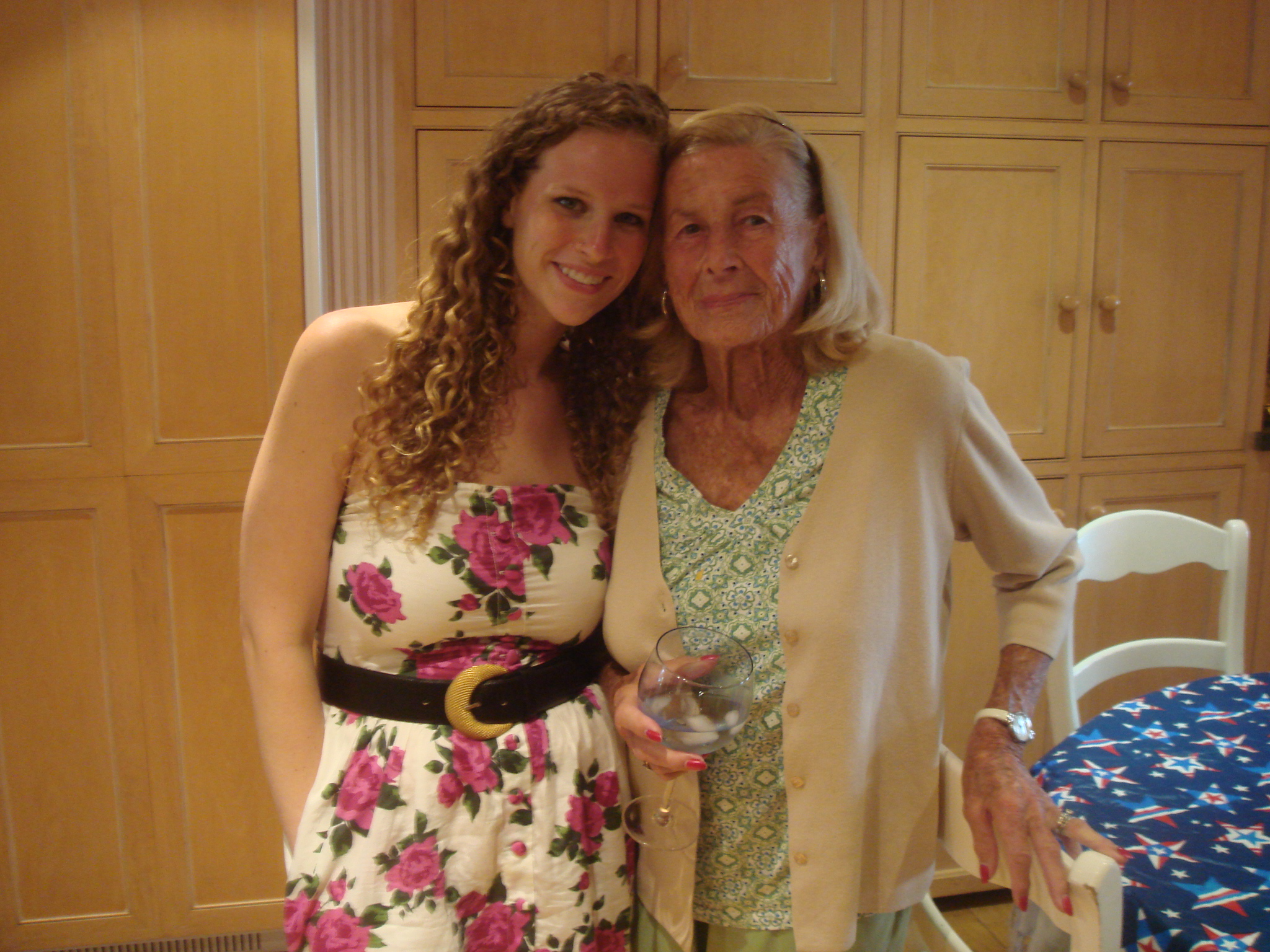
Our grandmother is 94 years old. She is the queen of getting herself out of tough conversations and giving responses that say everything and nothing at all. These are her best responses that have become invaluable to us and have turned into life lessons and tips throughout the years. We wanted to share them with you:
“Why not?”
It doesn’t matter if I am ordering an ice cream cone at 8 a.m. or trying on a ball gown just for the fun of it, her first response to me is most often, “why not?”. On occasion, “why not” is replaced with “might as well”. I could not count how many times this phrase has come to mind whenever I have nothing to say.
“Fouled up”
This is a lady’s way of using the F word. When we want to be a lady but also want to say the F word then just say that the situation is “fouled up”, just sayin. This works to describe pretty much any messy situation: untangle-able jewelry, a broken kitchen disposal, or a complicated family dynamic. All of these things can be categorized as “fouled up”.
“I thought so.”
This response comes in handy when, frankly, you don’t want to look like an ass. After every question you ask but feel like you should already know the answer, make sure to respond with, “I thought so”. You will forever seem like you knew what you were talking about.
“Tricky trick”
This is the favorite and most commonly replicated in our family. Usually after someone brings up a tough situtation and you aren’t sure what to say, “tricky trick” is always in your back pocket. The hard part is not using it too many times in one conversation. This is why there are many variations on the phrase. For example, when a situation is too “fouled up” to talk about any more, you can say, “On to the next trick!”. “On to the next trick” both ends the conversation and provides the wisdom that there will always be another “tricky trick” down the road, so don’t get too bogged down in the one right in front of you. “Tricky trick” can also serve as a boiler plate for similarly worded phrases such as “funny fun”, “spooky spook”, “nifty nift”, “rainy rain” and so on. You get the idea.
So those are just a few conversation tools that will help you along this holiday season filled with fouled up conversations! Feel free to give ’em a try and let us know how they went over.
Our brother, David, recently picked up a copy of the book Connectedat his local bookstore, The Booksmith, in San Francisco. It made quite an impression on him and he has captivated us with his thoughts on it. He lovingly agreed to do a two part post on the book and we’re so excited to share part one with you today. It is sure to enhance your perspective on your own life and humanity at large.
CONNECTIONS
A review and reaction to Connected, by David Feighan.
Connectedamazingly describes human social networks in a way that shifts your perspective to view a group as its own organism, instead of just a collection of individuals. Seen from this perspective, the significance of connections in everything is blindingly glaring.
First, let’s look at the premise of the book. To conceive of a social network, consider an ant colony or a flock of birds. The colony or the flock seems to have a life of its own beyond the individuals. For people, this is called “The Human Super Organism.”
The connections come to define the experience of individuals in the group and the group itself (similarly carbon atoms can be coal or diamonds, depending on connections). So how our social networks are formed have dramatically different effects for those involved, just as people have different cultures but nearly identical emotions. Since you don’t necessarily know your friend’s friends, no one can see his/her social network or his/her network placement. Networks are comprised of several degrees of separation, barring any member from seeing the network in its entirety.
We are all separated by 6 degrees. But social influence extends 3 degrees. This means that we cannot know the point from which we are being influenced. Free will is not as static as we think, and we are influenced more by external factors than we realize. We can choose to start a fight, but it is much less of a choice to be sucked into one.
For something invisible, social networks are important. They can affect up to 70% of a person’s behavior. Position in a social network can predict happiness better than race, class, gender, education and income. Positional inequality can be stark, but people can and do adapt to new positional roles rather effortlessly. Also, wealth and status are relative, so social networks reject dramatic income inequality.
Additionally, the group sets morality. Likewise, in a social network, if enough people believe a lie, it must be regarded as true; otherwise it threatens the fabric of the social network (think “The Emperor Has No Clothes”). Social networks are not inherently good or evil, and connections can harm you, but they are more likely to be beneficial and to conduct and retain positive energy.
Connections are self-perpetuating. Central people are more likely to be happy; people treat them more altruistically. People on the edges are lonelier and are more likely to think that society doesn’t work. Plus, social networks can fray at the edges. As one person disconnects from the group, they created a new set of people on the edge, who are now more likely to disconnect as well. By tending to those on the edge a person can prevent network decay and improve his/her own life.
*People only have the mental capacity for up to 200 connections. The low number is because we have to track the interconnectivity of all 200 people.
Putting positive energy into our networks is actually in our own best interest because it is multiplied and contagious, boomeranging back. In fact, many people designate a spot for God when asked to draw their social networks, essentially connecting everyone to everyone with love. Social networks simply create a feeling of oneness. Consequently, friendship and loyalty can trump self-interest. Altruism, love, reciprocity, trust, sympathy, compassion and generosity spread throughout a social network and are essential to it. Being nice is actually the most efficient way to be happy.
Our connections are among the most valuable things we have as human beings. Connected says, “When we have lost our connections, we have lost everything.” Certainly, the idea that exile was once considered worse than execution is one example of this; so is solitary confinement.
We are only measurable relative to our connections. So, by breaking into the impenetrably dense (trillions of connections) structures of social networks, perhaps social networks can address some paradoxes in our lives. People are increasingly screaming at the world about seemingly no-brainer threats to society, like climate change. Obviously, we are ruining our world. Yet, our social networks are dependent on an economy that exploits our natural resources. Individuals can see this and act on it, but social networks cannot. Giving way to the power of networks, this leads people to identify with what Foucault called “regimes of truth,” which allow for cognitive dissonance (subjective and unconscious denial of facts).
So if the existence of social networks confirms the absense of objective truth, than the only real reality is the life-blood of social networks – love.
This isn’t just a reference to romantic love, but what is necessary to social networks: altruism, reciprocity, trust, sympathy, compassion and generosity. Going further, people are unconsciously connected, such as sensing when someone is looking at the back of your head, or sensing when a loved one is about to call your phone. Studies have shown that this feeling is based on emotional proximity, not physical proximity. Couples describe this all the time –their connection was so significant, it trivialized everything else.
So, how can we blow smoke across the lasers that are our interpersonal relationships? Tune in for part 2 to find out.
*Connected was written by Nicholas Christakis and James Fowler, of Harvard and UCSD, respectively. It details and explains the nature of human social networks studied as a whole. It was published in 2009, and since, the term “social network” has come to define websites more than our flesh and blood social lives. Please remember that “social network” refers to groups of people both in real life and the digital world.


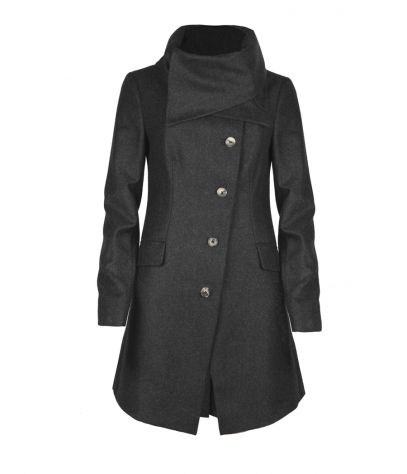 I really love the asymmetric look of jackets. This one in particular is so lovely and so out of my price range 😉




























 sisterdisco.com