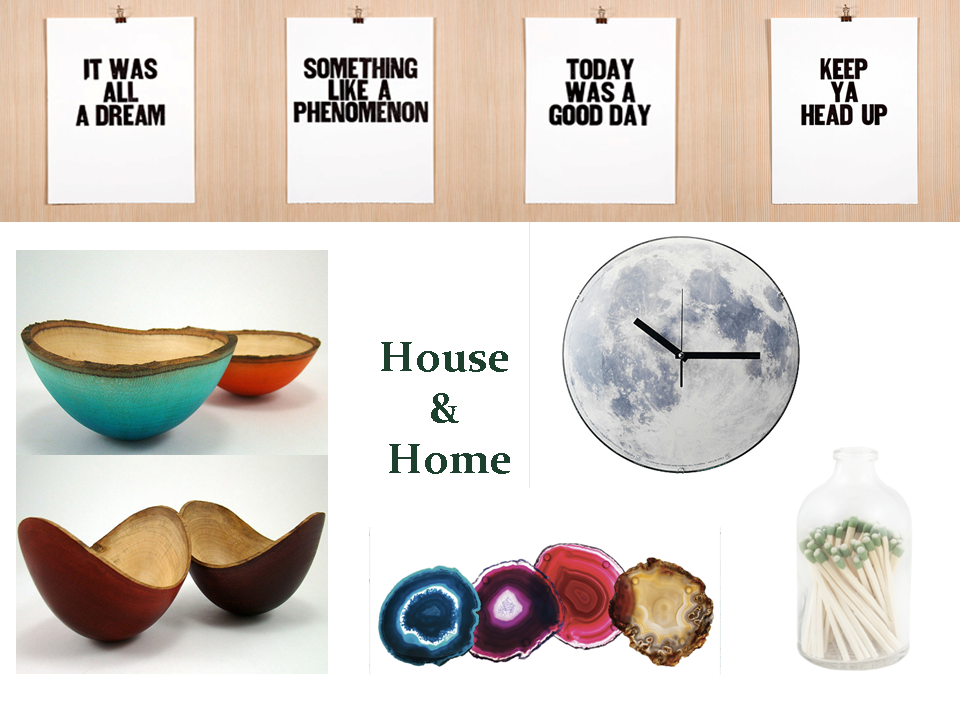
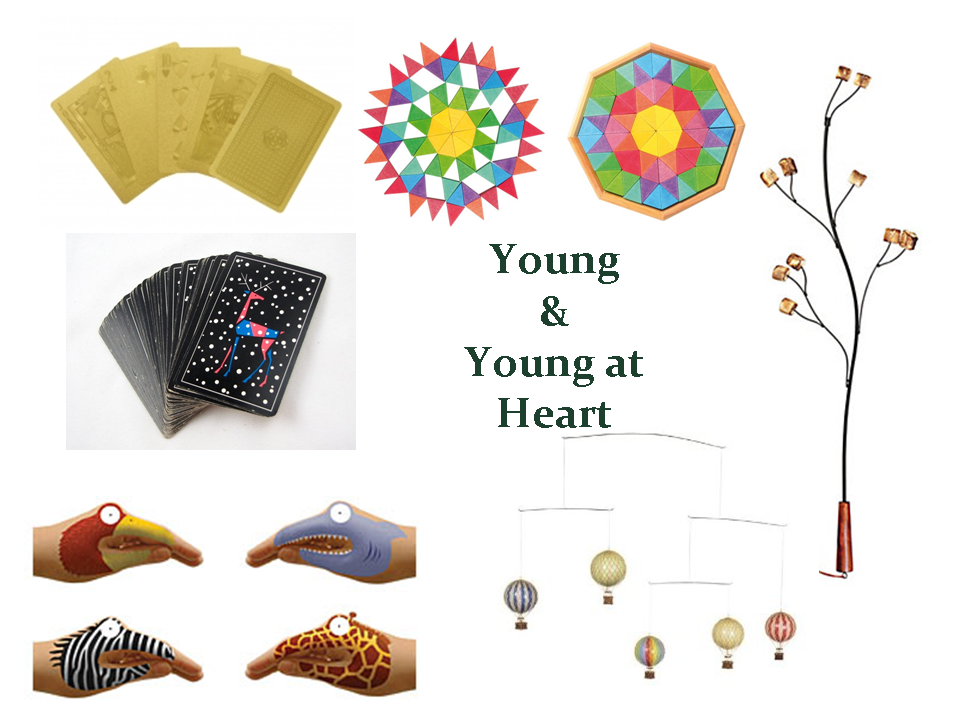
I’m more of a last minute kind of gal when it comes to Christmas shopping (and pretty much everything else, if we’re being honest). But this year, I got a bit of a head start on my online shopping perusal and put together this little gift guide. I hope you enjoy it!
Each week we take one word and each do a post based off that word. This week we’ve chosen the word vivid. Enjoy!
*Scroll over images for location information and click through for source info. Most images via Plenty of Colour.
Researchers Trace Roots of Vivid Memories
Researchers have found that calling up vivid memories—the face of a loved one or the chords of a favorite song—activates regions of the brain responsible for processing sensory experiences. When a person recalls a vivid memory, some of the sensory regions of the brain responsible for etching the original memory are reactivated.
In an article published in the September 26, 2000,Proceedings of the National Academy of Sciences, Howard Hughes Medical Institute investigator Randy L. Buckner, Mark E. Wheeler and Steven E. Petersen at Washington University in St. Louis describe how they used functional magnetic resonance imaging (fMRI) to probe the roots of a longstanding hypothesis in the field of memory research. According to the reactivation hypothesis, brain regions that are activated when a person has a sensory-specific experience are reactivated whenever the person remembers that experience.
Over the past couple of years, I’ve started to pay more attention to street art. I seem to be drawn to the written messages that people put out there. I wonder where they came from and why the artists choose to convey whatever it is they have. Below are a few shots I’ve taken of things that caught my attention.
“You Would” is written all over my neighborhood. I find it to be a particularly strange message and don’t know quite what to make of it. Much to my amusement, someone has started responding, spraying along side “Yea, so would you!”.
Along these lines, if you haven’t yet seen it, I’d highly recommend checking out the documentary “Exit Through the Gift Shop.”
As you begin your Thanksgiving break, our cousin DJ Nett Rockwell has sent over a playlist to get you groovin’. Turn it up as you head out of town, mash those potatoes and relax with friends and family.
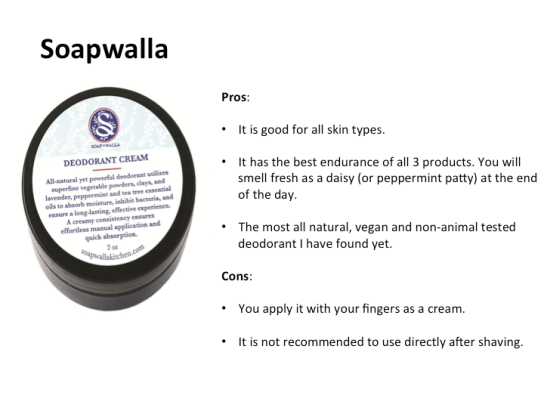
Lets be honest, having stinky pits is well “the pits”. One of my biggest challenges while I was transitioning to all natural products was finding a good deodorant. It has been one of the trickiest items to find. Without getting super preachy on you, here are some of the reasons why your average deodorant is not the best for you in the long run.
Aluminum: Aluminum is a neurotoxin linked in studies to detrimental health effects in lab animals. It was thought to be associated with Alzheimer’s, but data is inconclusive and controversial. One human study found it in breast tissue, and given the proximity of armpits to breasts, it seemed to indicate aluminum’s ability to migrate from the armpit into the body. Perhaps that’s thanks in part to….
Penetration enhancers: That’s a fancy term for ingredients that help carry other ingredients—often the active ones—into your body so they can do their job. There are many different kinds, like propylene glycol and Disodium EDTA. Often, these ingredients on their own are not the worst of the bunch—but they can be problematic because they basically work as an express lane for the absorption of more troubling ingredients.
Triclosan: Triclosan is an antibacterial agent that is so controversial that even the FDA is getting mad about it. It’s in antiperspirant and deodorant because the thing that makes people smell is bacteria—not sweat. It’s been shown to be a hormone disruptor capable of changing the sex of fish, and it’s also suspected to be responsible for certain strains of resistant bacteria.
Fragrance: A major difference between one brand’s “Swagger” antiperspirant and its “Classic” is the smell—a proprietary blend of chemicals lumped together under the vague rubric of “fragrance.” Check last week’s post for a refresher on why this blanket term is often hiding possibly problematic other ingredients inside your products.
BHT: While less commonly used, this bad-boy is linked in studies to nervous-system effects at low doses, is dubbed “expected to be toxic or harmful” by Environment Canada’s Domestic Substance List, and there are studies linking it to the C-word.
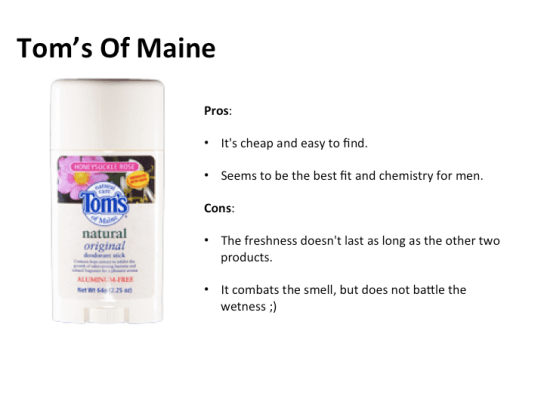
I wanted to be able to help you out in your search, so you don’t have to go through the trail and error that I did. Below are my top 3 natural deodorant picks. Click through the images for the product site. You can purchase all Tom’s of Maine products at almost any drugstore and at Whole Foods.
Every week, we pick a word and each do a post on that word. This weeks word is impression.
After reading the Kite Runner, my impression of Afghanistan changed. I saw a different perspective and point of view. In some ways, my interest of it intensified as I realized I did not know enough about this country. This video shows a different perspective of this beautiful country and its people.
I love Bill Hader. His impressions are hilarious and he always has me laughing out loud. I love this impression he does of Rick Perry, its just too much.
“Arguably, the core of our yoga practice is the work that we do to purify, reforge, and replace the inner patterns that in Sanskrit are called samskaras. Samskaras are the accumulated impressions—in scientific terms, the neuronal patterns—that create our character, our ways of thinking and acting, and our perspective on life.
The word samskara can be translated just the way it sounds in English: as “some scars.” Samskaras are energy patterns in our consciousness. I always picture them as mental grooves, like the rivulets in sand that let water run in certain patterns. Samskaras create our mental, emotional, and physical default settings.
The tendency to think “I can’t do this” when you’re faced with a new challenge is a samskara, and so is the confidence that develops once you’ve mastered something that was hard for you. The tension lump that shows up in your right shoulder when you feel stressed is a samskara, and so are the song lyrics that pop into your mind unexpectedly and—in my case at least—often reveal themselves to be the perfect comment on the situation that you’re in at the time.
Neurophysiologists mapping neural pathways in the brain report that each time we react in a certain way—getting angry, for instance, or procrastinating yet one more time—we strengthen the power of that pathway. The yogic texts make the same point. The bottom line in each case is that the way we feel, the way we react, and the behavior we manifest at any given moment are the result of samskaras, or neural connections, operating under the surface.
Once the samskaric pathways have been set, most people just keep running down them, like rats in a maze, reacting with the same old patterns and feelings every time they find themselves in a situation that seems to mirror whatever the original trigger might have been…
…The brain is so fluid and malleable, so prone to take and hold impressions, that when we keep leading it into new pathways, the accumulation of new insights, practices, and experiences will eventually overwhelm the old ones and, given the right circumstances, even eliminate them entirely.”
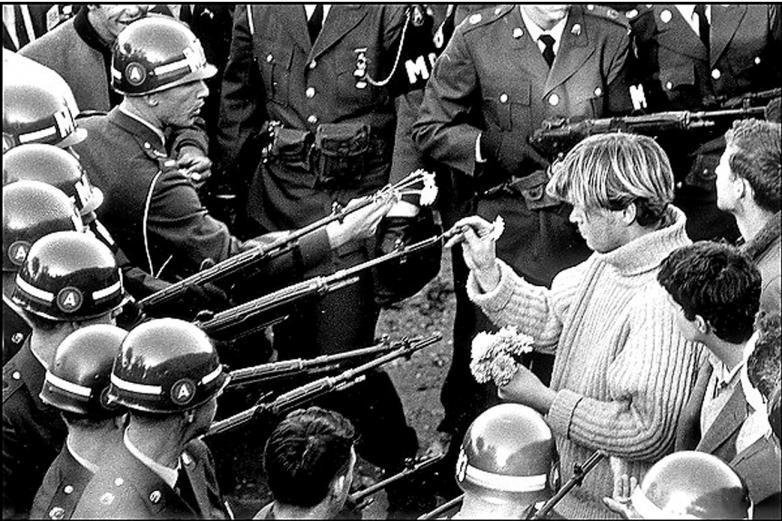
At the beginning of October I went to a mediation at Occupy Wall St. It was pretty intense and energizing. Later that night, I was talking to Suz (my second mom basically) who was around my same age during the Vietnam protests. She asked me if I was ready to hear her top tips for protesting. At the time, I thought they were pretty extreme, but as the movement progresses they seem just as relevant today as they were in the ’60s. I thought, given everything that’s going on now, I would share them with you.
Suz’s Top Ten Tips for Protesting
1. No loose jewelry, no earrings, no necklaces, no bracelets
2. Wear your hair up so as not to be pulled
3. Do not wear a scarf
4. Don’t wear open-toed shoes, rather shoes that you can run in
5. Don’t take a purse
6. Be aware of your surroundings
7. Keep ID, your phone and money on you
8. Carry a wet cloth in case of tear gas
9. Hold up a peace sign and stick a flower in his gun






























 sisterdisco.com